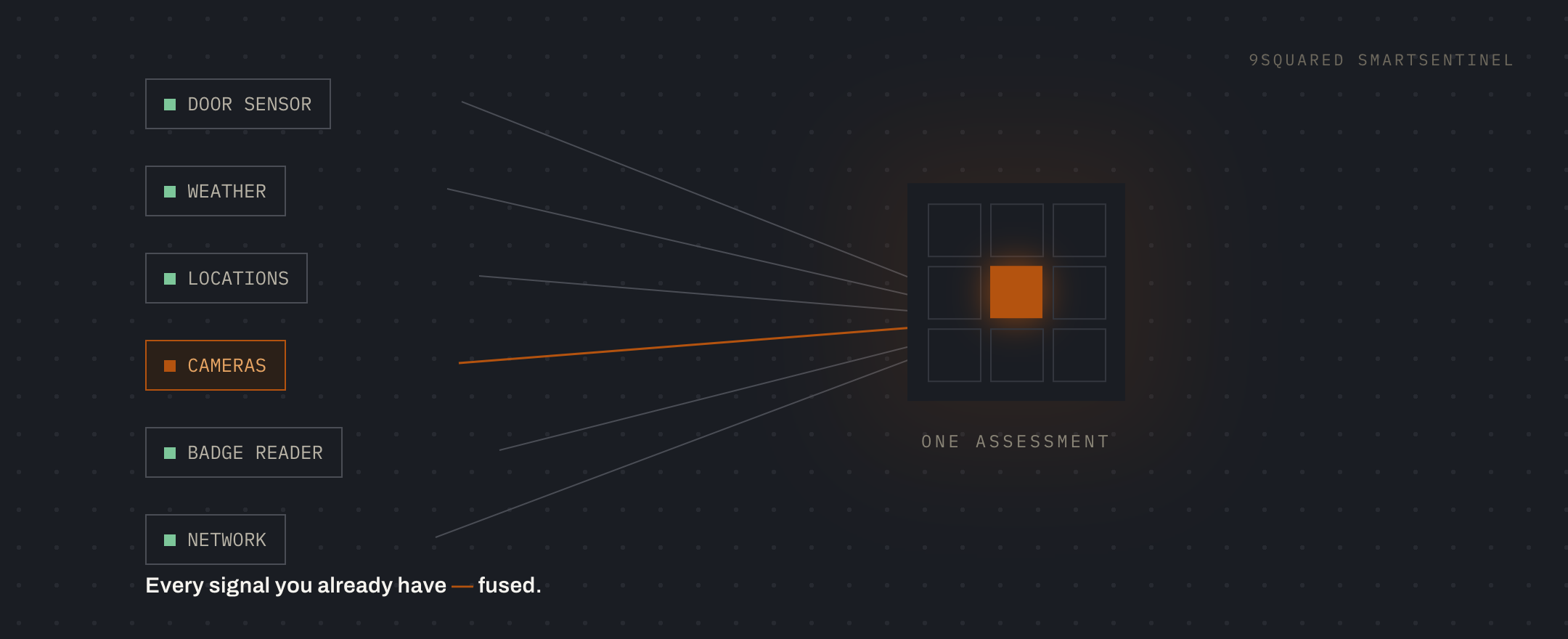
Every traditional alarm system, from the panel on your kitchen wall to the badge reader at your office door, shares the same design flaw: it makes a life-safety decision from a single bit of information. A contact opened. A badge scanned. That's it. The system's entire vocabulary is alarm or no alarm, and everything downstream — the monitoring-center call, the police dispatch, the 3 a.m. wake-up — inherits that poverty of context.
The numbers show what single-signal decision-making costs. The U.S. Department of Justice's problem-oriented policing guide on false burglar alarms found that 94–98% of police alarm calls are false, each consuming roughly 20 minutes of time for two officers — as much as $1.5 billion a year in police time (DOJ/COPS, False Burglar Alarms). Alarm calls make up 10–25% of all calls for service in many cities (ASU Center for Problem-Oriented Policing). In DeKalb County, Georgia, one year saw over 144,000 alarm calls — and just 39 actual or attempted burglaries (Cato Institute).
That failure rate isn't because sensors are bad. It's because a sensor answers only one question — did X happen? — when the decision that matters needs three: What happened? How serious is it? Who should do what, right now?
Answering those requires combining data sources. Here's what that looks like in practice.
A door opens: four versions of the same event
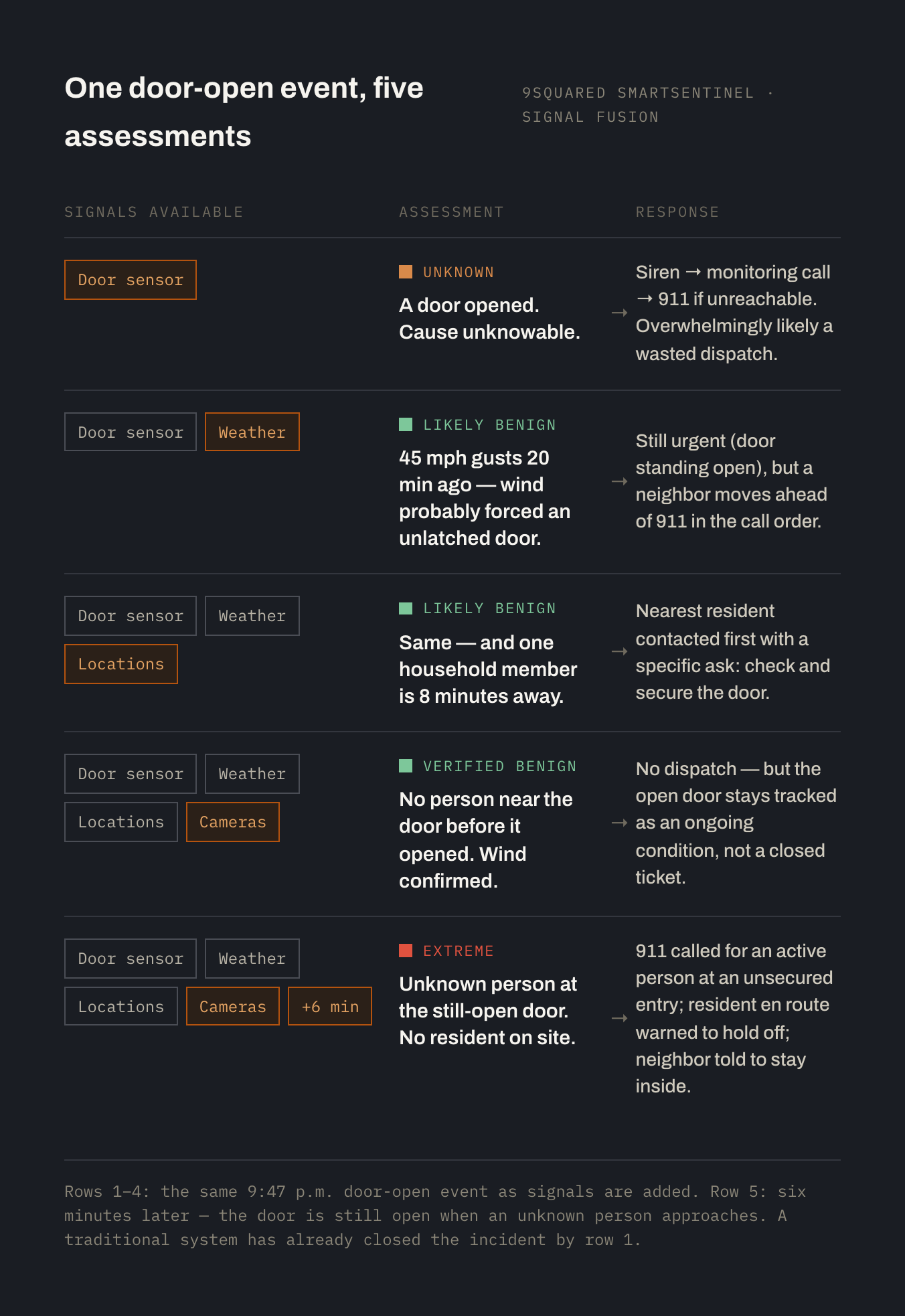
At 9:47 p.m., the back-door contact sensor at your house trips. Consider how the assessment — and the response — changes as we add signals.
Signal 1: the door sensor alone. This is the classic alarm system. You get a push notification or a siren. If you don't clear it, the monitoring company calls you; if they can't reach you, they call 911. The system knows one fact and has two moves. Statistically, that dispatch is overwhelmingly likely to be wasted — but the system has no way to know which kind of event this is, so it can't do anything smarter.
Signal 2: add the weather feed. A storm front moved through twenty minutes ago with 45 mph gusts, and your window sensors show vibration consistent with wind load. Now the most probable explanation is mechanical: the wind forced a door that wasn't fully latched. Note what changed and what didn't. The urgency of reaching someone is still high — your door is standing open at night. But the right responder changed. This probably doesn't need two police officers; it needs a person who can close a door. A trusted neighbor moves ahead of 911 in the call order.
Signal 3: add household locations. Your family's phones show one member eight minutes from home and the others across town. The additional signal doesn't just refine the threat assessment — it changes the response plan. The system now contacts the closest household member first, with a specific, actionable message: "Back door open, likely wind, you're nearest — can you check and secure it?"
Signal 4: add cameras. The doorbell and backyard cameras confirm it: no person approached the door in the minutes before it opened. The wind hypothesis is now verified, not just inferred. A traditional monitoring company, if it ever had this much information, would close the ticket here.
And that's exactly the trap.
The part single-signal systems get catastrophically wrong
The door is still open. Six minutes later, an unrecognized person walks up the driveway and pauses at the open door.
The traditional system already cleared this alarm. No sensor re-trips — the door is already open. If police weren't dispatched, nothing further happens. The one moment that actually demanded escalation is invisible to the system that "resolved" the incident minutes earlier.
A fused system — this is precisely what we built 9squared SmartSentinel to do — treats the open door as an ongoing condition, not a closed event. Camera analytics against the open-door condition produce a new assessment: unknown person + unsecured entry + no resident on site = extremely elevated threat. The response recomposes in seconds:
- Police are called immediately — not for "an open door," but for an unidentified person at an unsecured entry, which is a categorically higher-priority call.
- The household member en route gets an urgent hold-off warning: do not walk in; there may be an intruder.
- The neighbor is told to stay inside and observe from a distance.
Same door. Same evening. Four different correct responses, and the correct response reversed twice as signals arrived. No single sensor could have navigated that.
The office: a badge that's exactly where it should be
Office security has richer data and, oddly, wastes more of it. Here the failure mode is usually the opposite of the noisy home alarm: the event that should alarm doesn't look like an event at all.
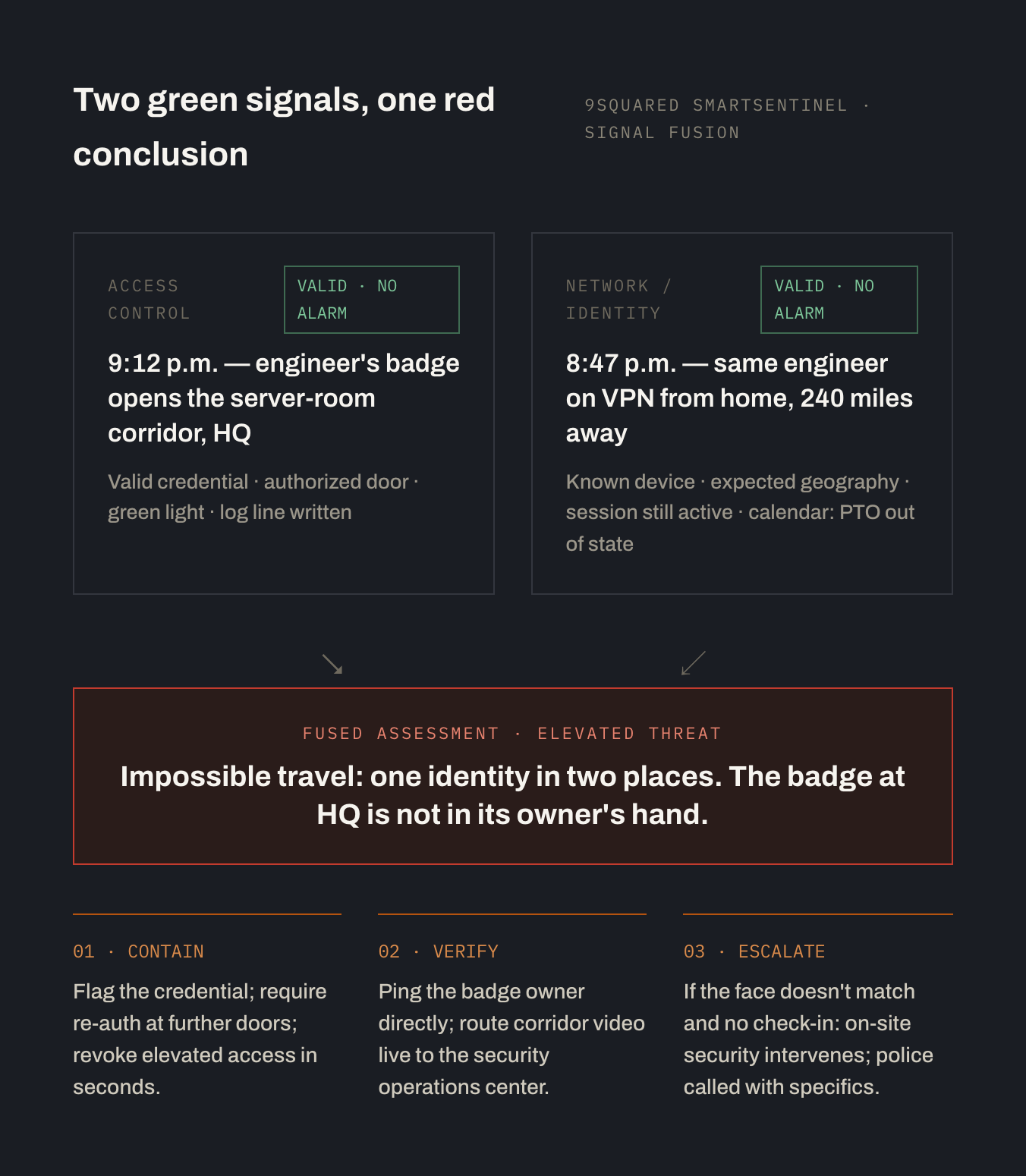
At 9:12 p.m., a badge belonging to a senior engineer opens the server-room corridor at headquarters. To the access-control system, this is a non-event: valid credential, authorized door, access granted, green light, log line written. No alarm exists to trip. On its own terms, the system is right.
But the corporate network tells a different story. Twenty-five minutes earlier, that same engineer's laptop authenticated to the VPN from her home — 240 miles away — and the session is still active, with her calendar showing she's on PTO out of state. One identity, two locations, an impossible itinerary.
Neither system, alone, sees a problem:
- Badge system: valid badge, valid door. ✅
- Network system: valid login, known device, expected geography. ✅
Fuse them and the picture inverts: the badge at headquarters is almost certainly not in its owner's hand. It's lost, cloned, or borrowed — and it's currently opening doors to your most sensitive room.
The fused response is also more proportionate than anything a single system could produce. This isn't a 911 call — no statute is obviously being broken by a badge swipe, and an armed response to what might be a contractor holding a borrowed badge would be its own kind of false alarm. Instead, SmartSentinel's playbook looks like:
- Contain: flag the credential, require re-authentication for further doors, and lock elevated access from that badge — within seconds, not after Monday's log review.
- Verify: ping the engineer directly ("Are you at HQ right now?") and route live camera video from the corridor to the security operations center.
- Escalate on evidence: if the person on camera isn't the badge holder and doesn't check in, on-site security intervenes and police are called with specifics — a physical intruder using a cloned credential in the server corridor — rather than a vague after-hours report.
The home scenario was about suppressing a false positive and then catching the real threat behind it. The office scenario is about surfacing a true positive that produced no alarm at all. Both are the same underlying capability: no single data source contained the answer.
Small numbers, colossal improvements
Security incidents are rare, which tempts people to dismiss these gains as marginal. The arithmetic says otherwise.
Suppose your home has two door-open events a year — one caused by weather, one by an actual intrusion attempt. Compare the outcomes:
| Outcome (per year) | Single-signal system | Fused system (SmartSentinel) |
|---|---|---|
| Wind event → police dispatched | 1 wasted dispatch | 0 — neighbor closes the door |
| Real intrusion → correct escalation | Often cleared or delayed | Police called with active-threat context |
| Wasted police dispatches | 2 | ≤1 |
| Genuine incidents handled correctly | 0 | 1 |
| Resident walks in on an intruder unwarned | Possible | Warned before arrival |
"From 0 to 1" and "from 2 to 1" look like small deltas. They aren't. Going from zero correctly-handled intrusions to one is not a 50% improvement — it's the difference between a security system that works and one that doesn't. And halving wasted dispatches is exactly the direction cities are already forcing from the other end: when Salt Lake City required verification before dispatching to burglar alarms, alarm-response calls fell about 87% — and burglaries fell 26%, because officers' time went to real threats (Salt Lake City Verified Response study). Verification works at city scale. Data fusion is verification, automated, at the scale of your own property.
At an office, multiply by the asymmetry of stakes: one undetected cloned badge in a server room can cost more than a decade of false-alarm fines. Detecting it requires no new hardware — the badge logs and VPN logs already existed. They had simply never been asked to talk to each other.
The takeaway
Sensors are cheap and getting cheaper. The scarce resource is judgment: deciding what an event means and what to do about it, in the seconds when it matters. Every added data source improves both halves of that decision — the threat assessment and the response selection. Weather data changed who to call. Location data changed who to call first. Camera data first de-escalated, then re-escalated with specifics that made the 911 call actionable. Network data turned a green checkmark into a contained breach.
That's the design principle behind 9squared SmartSentinel: every signal you already have, fused into one continuously-updated assessment — so the response is always proportionate to what's actually happening, not to what one sensor happened to see.
Sources: DOJ/COPS Problem-Oriented Guides for Police: False Burglar Alarms · ASU Center for Problem-Oriented Policing, False Burglar Alarms 2nd Ed. · Blackstone, Hakim et al., burglar alarm economics · Burglary reduction through private alarm response (Salt Lake City VR study)